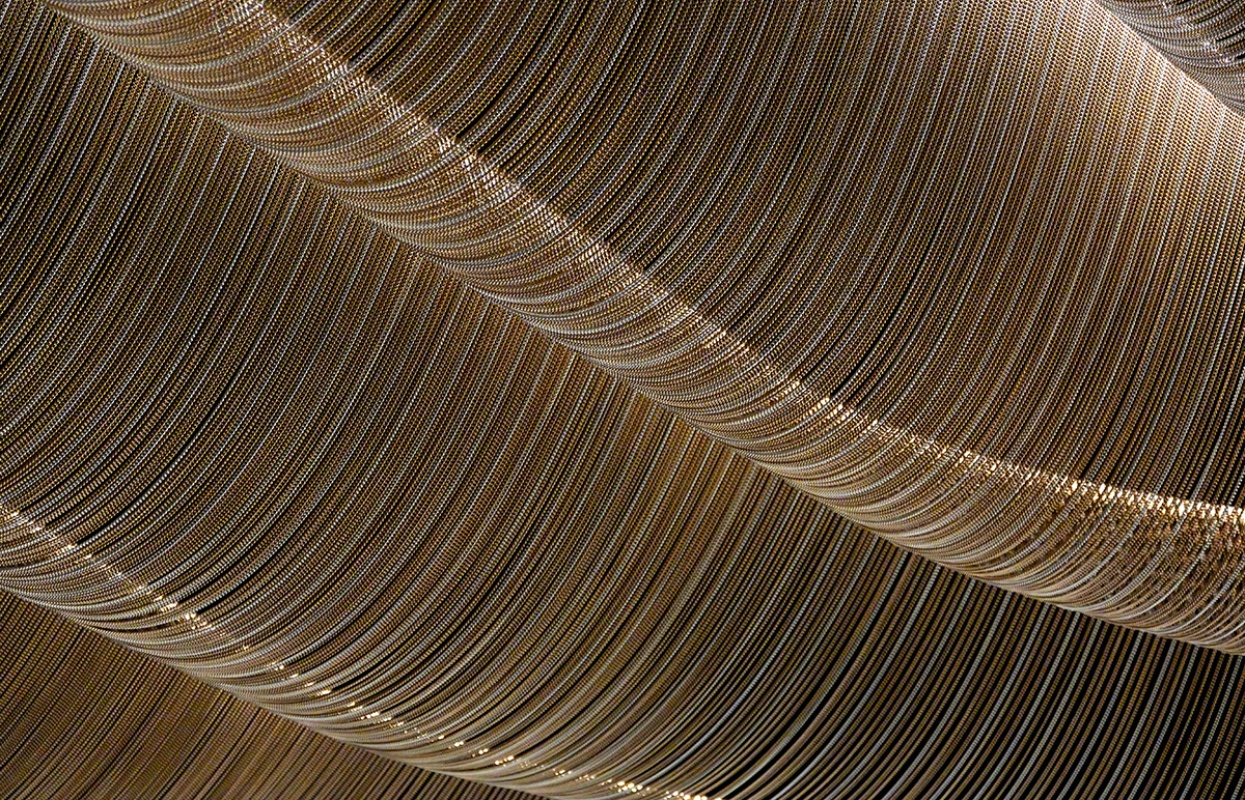
A detail of the wave-like lattice chainwork suspended from the ceiling, its rippling texture adding depth to the atrium.
Westlake 66 stands between West Lake and the Grand Canal, in a part of Hangzhou where natural landscape and commercial activity have shared the same ground for centuries. Next to Wulin Square, in the heart of one of the city’s most established commercial centres, the mixed-use retail and lifestyle development draws directly on this context. Developed by Hang Lung Properties, the project is set to open in phases from 2026.
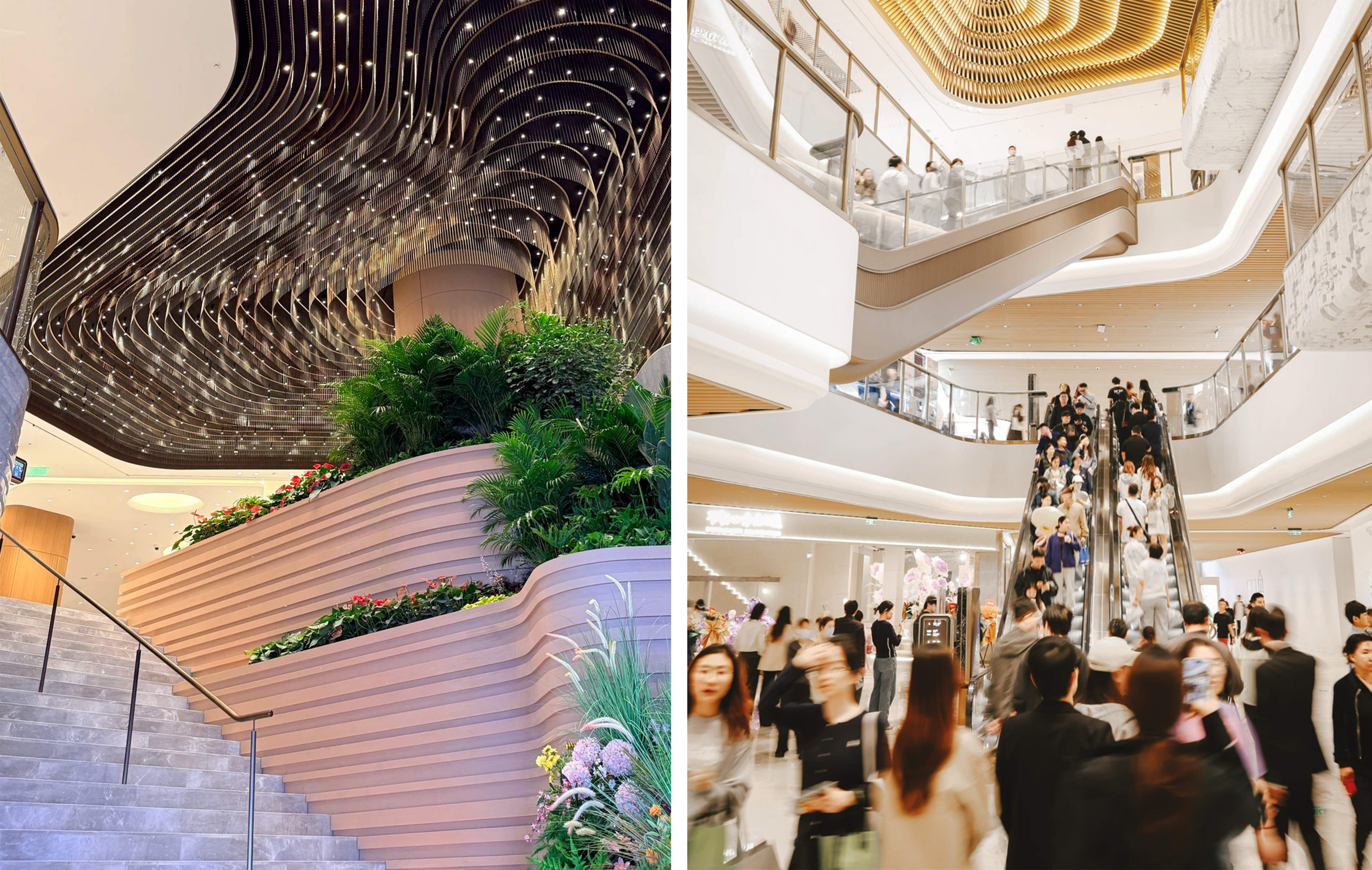
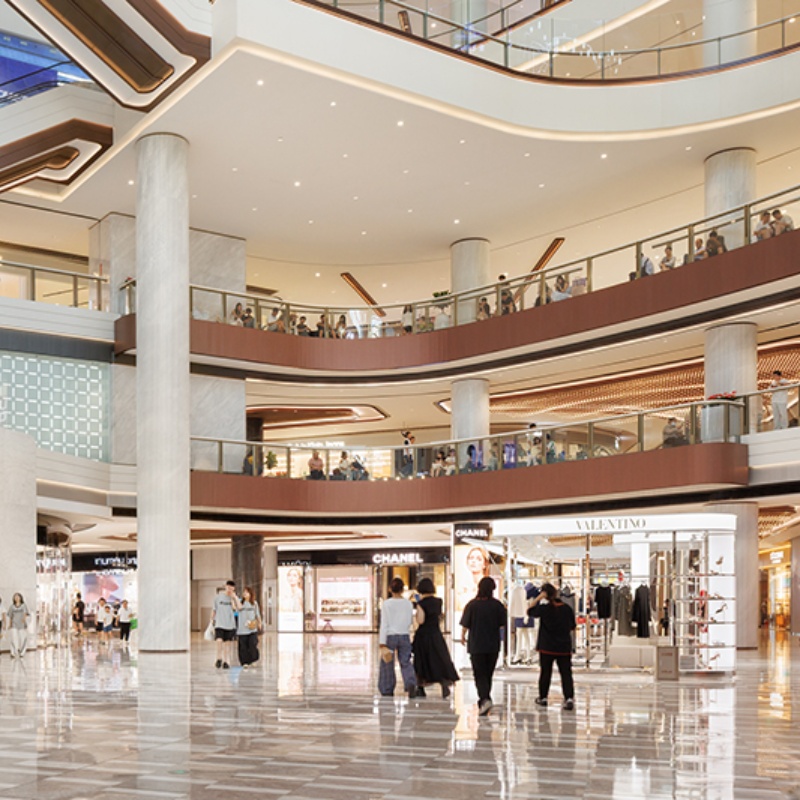
(right) Visitors move between levels below the golden, ribbed ceiling, the terraced forms guiding the main walking routes.
Our brief was to create a destination with genuine cultural substance. Rather than relying on a stylistic interpretation of heritage, we aimed for a design that speaks directly to how this city came to be.
Baijingfang and the placemaking narrative
The central concept draws on the site’s historical identity as Baijingfang, literally ‘the place of a hundred wells’. Hangzhou’s pre-modern urban fabric was threaded with these water sources, which served as communal focal points where residents gathered to draw water, exchange news and build neighbourhood life.
Rather than a literal translation, the well informs our placemaking narrative. A network of social spaces distributed across the complex gives the architecture a fluid rhythm. Moving between them, visitors are carried through the space as if by a current: drawn forward by light, slowed by texture, or brought to a pause as the architecture opens into a courtyard or rises into a soaring ceiling. The experience feels intuitive, weaving sightlines and retail circulation into a continuous stream of discovery across the stacked floorplates and fused public realm that define the identity of the place.
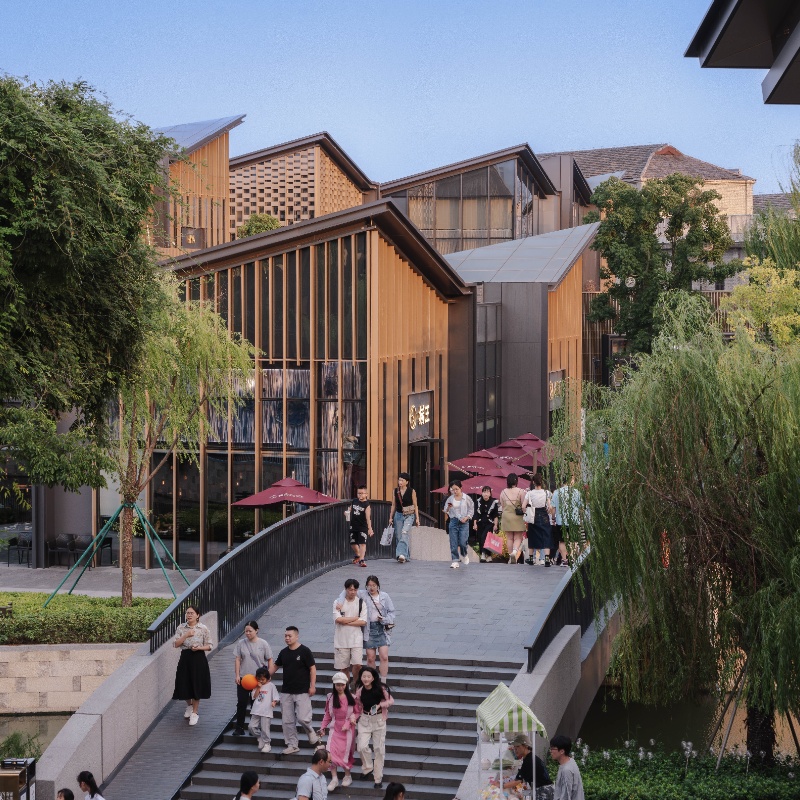
The same spatial logic flows from inside to outside. The complex is conceived as a connected whole, shaped by the movement of space and light through the retail strata, with outdoor spaces – sunken courtyards, landscaped terraces, an extensive podium garden, and tree-shaded streetscapes – forming as much a part of the network as the retail floors themselves.
Light, material and atmosphere
Within the retail space, the strongest visual impression comes from looking onward and upward. Dramatic sculptural ceilings, defined by stepped, terraced layers, are punctuated by skylights that draw in daylight like light filtering into a deep pool. The result is a series of cascading sculptural forms that define the project’s signature DNA and guide visitors along the main walking routes.
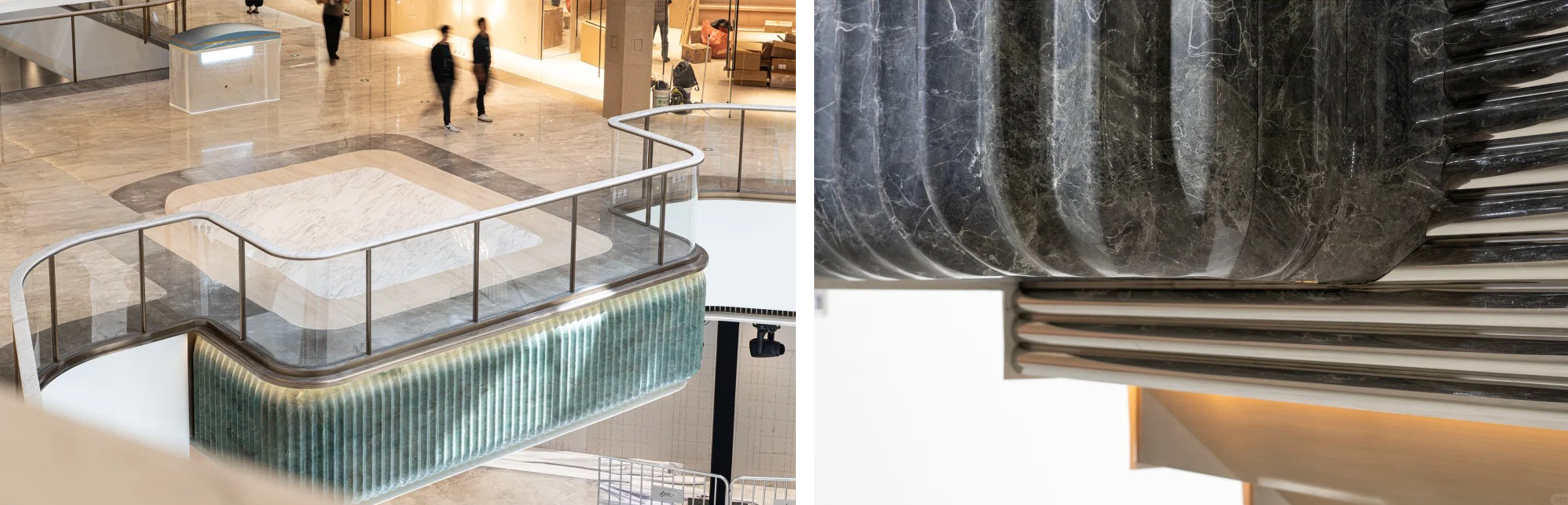
(right) Sculpted, fluted marble carries the project's distinct rippling quality down to the small architectural details.
One of the clearest expressions of this design language is Silk Wave Symphony, a sculptural skylight installation inspired by the tranquil waters of West Lake and Hangzhou’s long association with silk. Developed as a contemporary interpretation of the Hundred Wells narrative, the installation transforms the fleeting rhythm of rippling water into a suspended spatial composition. More than 60,000 finely arranged metal chains are suspended within a three-dimensional field, where gravity shapes them into flowing contours like strands of silk settling in air.
A complementary LED lighting system with sensor control extends the daylight ambience into the evening, with timed mood settings that reduce glare, enhance comfort and support energy efficiency. As daylight moves across the suspended surface, shifting reflections animate the installation and give the atrium a calm, contemplative rhythm.
Augmenting the natural light and greenery, the material palette is both warm and tactile. Sculpted, fluted marble and sinuous pressed metal carry a distinct rippling quality. Intricate, wave-like lattice chains add depth to key surfaces. Muted pastel colours draw on Song and Tang dynasty ceramics and the seasonal tones of Hangzhou’s lakeside landscape.
Within Silk Wave Symphony, layered tones of silver and nickel bronze recall the refined textures of Hangzhou Leno, luxurious brocades and the tonal richness of traditional natural dyes, turning each metallic strand into a contemporary thread of light, movement and memory. The same contrast and design integrity carries through from the base palette of fine-grained marble to the dynamic ceiling structures, elaborate washrooms, sculpted lift interiors and exquisite details that celebrate moments of joy throughout the project.
Balancing craftsmanship and technology, the installation reinterprets textile artistry through parametric design and precision fabrication. Studies of wave geometry, chain density, drape behaviour and daylight performance informed its development, allowing material, light and cultural memory to come together in an immersive expression of Hangzhou’s poetic landscape.
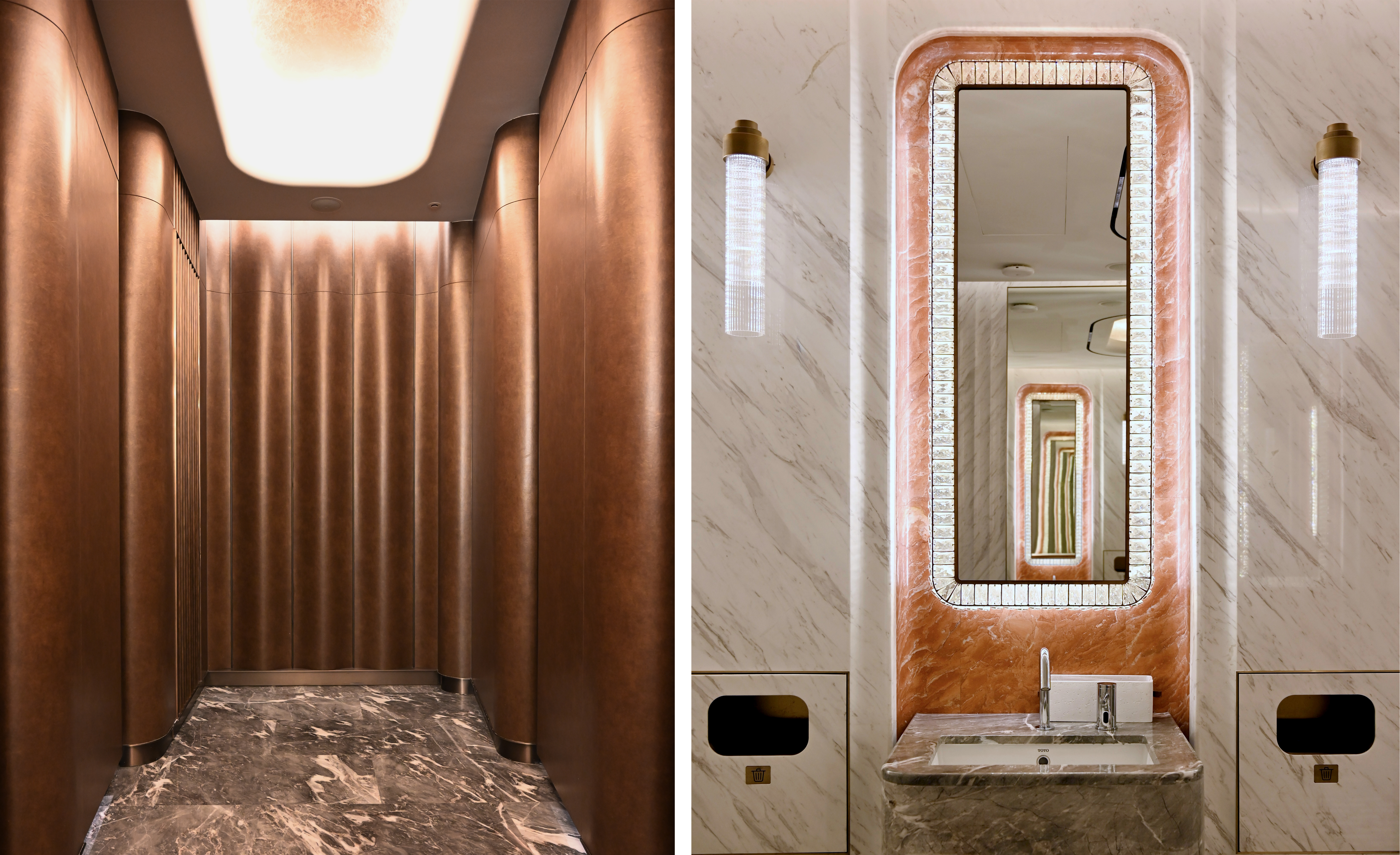
(right) Even the washrooms continue the material palette, with muted accent tones drawn from Song and Tang dynasty ceramics
Rooted in the city’s past, shaped for contemporary life
Moving through Westlake 66 becomes a physical encounter with the city’s past. Two retained heritage buildings anchor the public realm, while granite-lined streets, trees and garden spaces hark back to the wider history of the area. At the heart of the development, Song and Tang dynasty relics unearthed on site are integrated into an immersive exhibition space fluidly linked to the basement retail and a sunken garden at the southern corner of the site.
.jpg)
The project is designed with a younger, lifestyle-oriented audience in mind, appealing to people who value authenticity and spaces that reward exploration. Westlake 66 is a contemporary stage for the city’s social life, animated by a programme of cultural events and community activities that will sustain its energy and evolution.
.jpg)
With a second phase underway on a neighbouring site, Hangzhou mall site, the development will continue to flourish and cement its place as an iconic destination anchored to the landscaped open space of Wulin Square. The strategic site context fed by mass transit nodes to the North and South will ensure the long-term vibrancy and connectivity with the wider district and create a place where commercial energy and cultural identity reinforce one another in a city that has always found its character in the spaces where people come together.